Paris remains the most sought-after office market in France, and its prices reflect that. In the Central Business District (QCA), prime rent reached €1,230/m²/year (excluding VAT and service charges) at the end of 2025, up 11% year-over-year and at a record high. (Source: JLL)
By early 2026, this prime rent is expected to stabilize at around €1,220 to €1,250 per square meter per year, depending on the source. (Source: CBRE)
Behind this record, two trends are working in favor of businesses.
First, the rebalancing of the traditional market. In the Île-de-France region, take-up reached 1,638,100 m² in 2025—a historic low excluding 2020— down 9% year-over-year and 25% below the 10-year average. At the same time, immediate supply peaked at 6.2 million m², and the vacancy rate climbed to 11.2% ( Source: JLL). As a result, tenant companies have more room to maneuver, with incentive packages—including rent waivers and renovations covered by landlords—averaging 24% in the Île-de-France region.
First, the rebalancing of the traditional market. In the Île-de-France region, take-up reached 1,638,100 m² in 2025—a historic low excluding 2020— down 9% year-over-year and 25% below the 10-year average. At the same time, immediate supply peaked at 6.2 million m², and the vacancy rate climbed to 11.2% ( Source: JLL). As a result, tenant companies have more room to maneuver, with incentive packages—including rent waivers and renovations covered by landlords—averaging 24% in the Île-de-France region.
Next, the rise of the flexible hose.
Serviced offices and coworking spaces now account for 5.9% of Paris’s office inventory, with more than 1.6 million square meters in use. (Source: Ubiq) This underlying trend is confirmed on the corporate side: the use of coworking spaces could account for nearly 29% of real estate portfolios within two years. (Source: Carte Financement)
In other words, a prestigious address is no longer reserved for those who sign a 3-6-9 lease and finance their own renovations . It is now available on a monthly basis, fully furnished.
Traditional office, coworking space, managed office: What are we talking about?
There are three main categories of solutions in Paris, and confusing them wastes time during a search.
- The traditional office is rented under a commercial lease, most often a 3-6-9 lease: the company signs a lease for a minimum of three years, pays a security deposit, covers the cost of any renovations, and manages the space on a day-to-day basis.
- The coworking is based on a service agreement, without a lease. You can rent a flexible workstation in an open space or a dedicated workstation, by the day, week, or month, in a space shared by professionals who are independent of one another.
- The operated office (or “flex office”) takes this concept a step further: a private, enclosed office—or sometimes an entire floor—rented fully equipped with all services included, featuring a short-term commitment and a single monthly payment. This is the fastest-growing solution in Paris, as it combines the privacy of a private office with the flexibility of a shared workspace.
Major Office Districts in Paris: Where to Set Up Shop?
Paris isn't a single market but a mosaic of neighborhoods, each with its own demographic, rent levels, and atmosphere. Here are the main areas you should know about before making a choice.
The Central Business District and the Golden Triangle (1st, 8th)
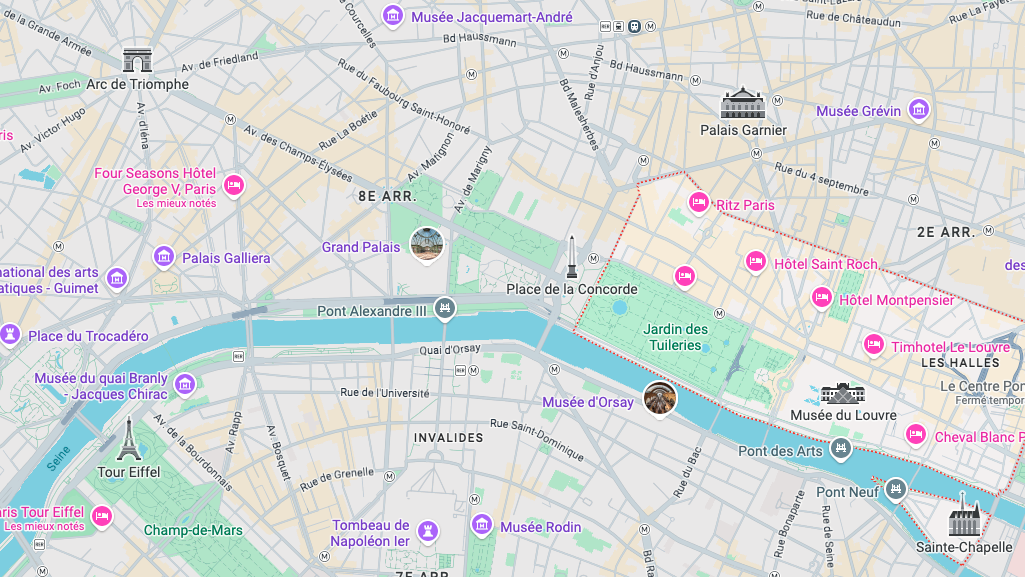
The QCA encompasses the 1st, 2nd, 8th, 9th, 16th, and 17th arrondissements and is home to alarge portion of Paris’s commercial real estate market. It is the premier location for corporate headquarters, consulting firms, law firms, and finance departments. The vacancy rate there remains very low, at around 5.3%, a sign of unwavering demand. (Source: JLL)
In the heart of the Central Business District (CBD), the Golden Triangle (the Vendôme, Opéra, and Champs-Élysées area) commands the highest premium rents, ranging from 1,150 to 1,230 €/m²/year, with extremely limited availability. At this market level, the address matters just as much as the premises themselves: it reassures customers, facilitates recruitment, and directly shapes the company’s image.
The Emerging North (18th)
Long considered a fringe area, the 18th arrondissement is emerging as the new hub for coworking, with a record penetration rate of 11.4%, driven by the opening of large coworking spaces. (Source: Ubiq) This is the way to go for organizations that prioritize flexibility and budget control.
When it comes to coworking, these geographic differences are also reflected in the cost per workstation: the central arrondissements remain the most expensive, with the 9th at €852, the 8th at €823, and the 7th at €820 per workstation per month, while the northern outskirts range from €300 to €500. (Source: Ubiq)
A 3/6/9-month lease or a flexible office space: Which should you choose in Paris?
Once the neighborhood has been identified, the most critical decision remains: whether to sign a traditional commercial lease or opt for a flexible office space. The two models do not address the same needs.
The 3/6/9 Commercial Lease
A commercial lease remains a viable option for a large, stable organization that wants to control its space layout and spread out its rent payments over time. In Paris, however, it requires a minimum three-year commitment, a substantial security deposit, a budget for renovations, and long-term management.
Above all, the total cost far exceeds the base rent: operating expenses, utilities, office tax, fit-out costs (up 25–40% since 2020), and restoration costs at the end of the lease. In total, the average total cost is estimated at €10,000 per employee per year in Paris. (Source: Échange Immo)
To break down this budget line by line—from rent to utilities—we went through the entire process.
Read the article: How much does an employee's desk really cost?
The flexible office and the staffed office
The flexible office turns the conventional approach on its head: you walk in ready to work, pay a single monthly fee (which includes utilities, furniture, internet, and services), and adjust the number of workstations as your business needs change.
No large deposit, no setup costs, and no day-to-day management. And this is no longer just a stopgap solution: the average contract duration will reach 14.3 months in 2025, a sign that this choice has become a structural one. (Source: Ubiq)
Is the hose more expensive?
The common misconception is that the flexible plan costs more per month.
This is often true for a small team, but the gap narrows significantly for large spaces once all the ancillary lease costs are factored in: a comparison of a 4,700 m² property in the 9th arrondissement shows that managed office space there isn’t necessarily more expensive. (Source: Ubiq) As a sign of a maturing market, negotiations are also becoming smoother: the gap between the listed price and the signed price is now only 5.33% in 2025, down from 10% a year earlier. (Source: Ubiq)
In the Parisian market, where flexibility is precisely what companies are looking for in 2026, this advantage has never been more important than it is today.
To help you decide based on your situation, we're comparing the two models side by side.
Check out our article: 3/6/9 Leases vs. Flexible Office Space: A Comparison
Overview of Coworking and Flexible Office Providers in Paris
The Parisian flexible office market is not only vast but also undergoing a major transformation. In 2025, 153,567 m² of space was opened, against a backdrop of consolidation marked by acquisitions and the departure of certain international players (Source: Ubiq). Understanding who operates what—and where—helps one navigate the market.
Among major national and international networks, IWG (Regus, Spaces) remains the leader in terms of the number of locations, while Wojo claims to be France’s largest network with approximately 170 spaces, including about ten locations in Paris and its inner suburbs. Morning, Deskeo and its Hopper concept, Newton Offices, and Startway round out this landscape, alongside real estate companies that are developing their own managed offerings, such as Gecina with Yourplace.
The geographic distribution naturally follows that of the market.
In the QCA and the Premium West (8th, 9th, 16th, and 17th arrondissements), the market is dominated by high-end brands: IWG (Regus, Spaces), Wojo, Deskeo, and Startway operate locations there in luxury buildings.
In the more creative eastern part of the city center(2nd, 3rd, 10th, and 11th arrondissements), the number of spaces is growing around the Sentier, the Canal Saint-Martin, and République, driven by operators such as Morning, Deskeo, and Comeandwork (part of the Chez Raoul group), as well as by coworking cafés designed for freelancers.
On the Left Bank and to the south (13th and 14th arrondissements), real estate agents like Wojo are taking advantage of new development projects in the area to offer recently built properties at more affordable prices.
For a broader and more detailed selection of the best places to work, we've put together a special overview.
Flex-O in Paris: two locations in the heart of the 8th arrondissement
In this landscape, Flex-O has opted for absolute centrality: its two Paris locations are both situated in the 8th arrondissement, in the heart of the QCA, with more than 1,086 workstations and 10 meeting rooms spread across two iconic buildings. It has everything included (utilities, furniture, internet, reception services) and without a commercial lease agreement.
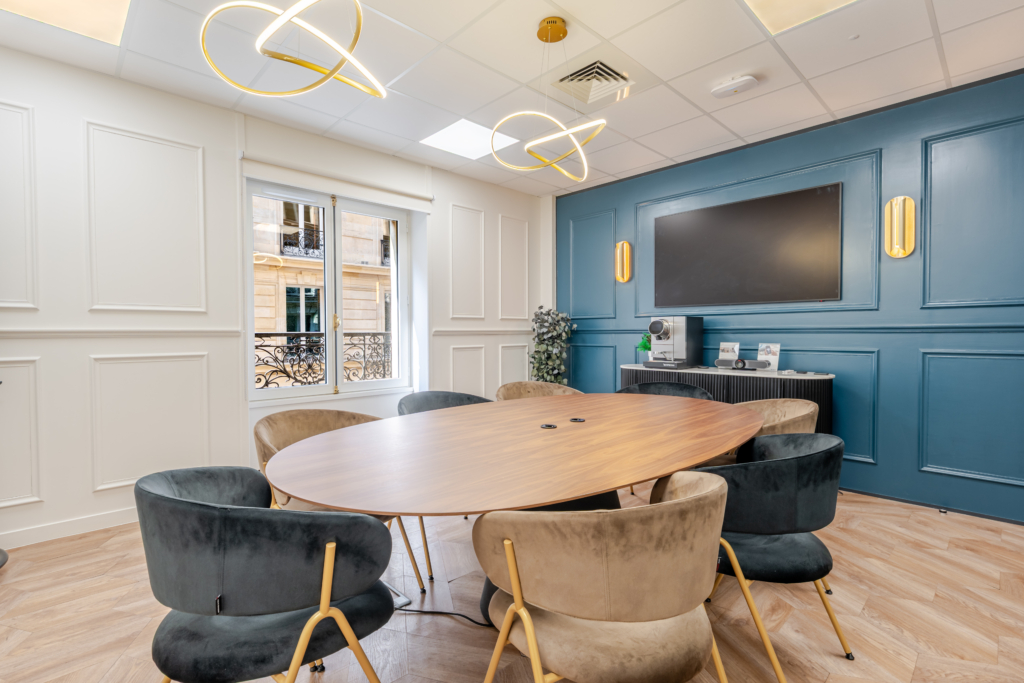
Flex-O Paris Monceau, at the edge of the park
Located at 47 rue de Monceau, in an iconic building at the foot of Parc Monceau, this center offers more than 1,500 m² of high-end, eco-friendly workspaces. It offers 206 workstations in private offices, coworking spaces, numerous self-service phone booths, two meeting rooms that accommodate up to 12 people, and an event space—all set within 170 m² of open spaces and a coworking café. It is accessible via the Monceau, Villiers, and Miromesnil metro stations.
Flex-O Paris Haussmann, 140 meters from Saint-Lazare
Located at 69 Boulevard Haussmann, 140 meters from the Saint-Lazare train station and just a stone’s throw from Printemps, the Palais Garnier, and the Madeleine, this center is situated on one of the capital’s most iconic thoroughfares. It spans 6,700 m² across seven floors of a Haussmann-style building organized around a tree-lined garden, featuring 879 fully equipped workstations, several private open spaces, 600 m² dedicated to coworking, eight meeting rooms for 4 to 12 people, 28 phone booths, and two event spaces available for private hire. A central, tree-lined terrace measuring 140 m² completes the complex.
The building’s accessibility is hard to beat: six metro lines (M3, M8, M9, M12, M13, M14) and two RER lines (A and E) surround the building, with optional underground parking available on the Rue des Arcades side, and shops and restaurants right at the building’s doorstep.
Offers and Rates at Flex-O Paris
Everything is included (utilities, furniture, internet, reception services) and there is no commercial lease commitment:
- Private Office : a private, fully equipped space in the heart of the QCA, starting at €900 (excl. tax) per workstation per month.
- Coworking Nomade: Flexible access to shared workspaces, starting at €219 (excluding tax) per month, for mobile professionals or those who work partially remotely.
- Meeting Rooms: 8 rooms accommodating 4 to 12 people, plus spaces that can be reserved for private use; pricing is based on a quote depending on the setup.
- Business Address : A prestigious Paris address for your business, starting at €85 (excl. tax) per month, with optional services.
When compared to the actual cost of a prime lease in the 8th arrondissement (base rent, utilities [approximately 20% more], fit-out, and maintenance), the all-inclusive package offered by a managed center radically changes the clarity of the budget.
Rent, utilities, furniture, energy: the total cost of a “typical” expense often holds some surprises. We’ve broken it down for you.
Read the article: How Much Does an Office Really Cost Per Employee?
Who is an office rental at Flex-O Paris intended for?
The variety of spaces makes it possible to accommodate a wide range of needs:
- A self-employed person or independent professional looking for a credible business address
- An SME or mid-sized company that sets up its headquarters in the 8th arrondissement without committing to a long-term lease
- Ascale-up whose workforce is growing rapidly
- A large corporation that is opening a branch or a project office in central Paris
The flexible workstations and spaces can accommodate anywhere from a single person to a team of several dozen.
Not sure which format to choose or what criteria to compare? Our guide covers everything you need to know.
In conclusion
Renting office space in Paris in the best locations without being locked into a rigid lease—that’s the promise of flexible office space. In a market that’s at record highs but offers more room for negotiation, the best approach is to think in three steps: identify the neighborhood that’s right for your clients and talent, choose between a traditional lease and a flexible arrangement based on your growth trajectory, and then compare providers based on the services actually included.
Located in the heart of the Central Business District, the two Flex-O centers in the 8th arrondissement deliver on this promise: prestigious locations, Haussmann-style buildings, fully equipped workstations, terraces, premium services, and flexible lease terms. Everything you need to set up your business in Paris, on your own terms.