An office suited to an SME is a workspace whose size, cost, and lease term are commensurate with the company’s actual size, without excess capacity or disproportionate fixed costs. Unlike a large company, an SME operates with a workforce that fluctuates rapidly due to new hires, departures, and periods of peak activity.
The ideal office for an SME therefore combines three qualities: adjustable floor space, controlled costs, and a professional setting for hosting clients and partners. It is this combination that is prompting more and more business leaders to move away from traditional commercial leases.
To learn more about the day-to-day benefits of coworking for a small business, our dedicated article details the tangible advantages beyond just the price.
Read the article: Coworking Spaces for Microbusinesses and Small and Medium-Sized Enterprises
Key Criteria for Choosing Office Space as an SME
Before comparing the available plans, it’s helpful to clarify what really matters to a small or medium-sized business. Four criteria consistently come up in executives’ decision-making.
The Budget and Hidden Costs
The listed price of an office space never reflects the total cost. A standard commercial lease involves renovation work, furniture, building maintenance fees, upkeep, and often a security deposit equivalent to several months’ rent.
Conversely, the price of a private office in a coworking space ranges from €280 to €850 per month depending on the city, with a Paris average of €689 per month for a private office in 2025 (Source: Ubiq). This budget transparency is particularly valuable for an SME that needs to manage its cash flow with precision.
Included services
High-speed Internet, fully equipped meeting rooms, visitor reception, cleaning, maintenance: every service that doesn’t have to be handled in-house frees up time for core business activities. For an SME without a dedicated general services department, this comprehensive support makes a tangible difference in the day-to-day operations of its teams.
To compare the key considerations for these different plans in more detail, a dedicated guide outlines the criteria you should review before signing.
Traditional office, coworking space, or private office: Which option should you choose?
Today, three models shape the commercial real estate market for French SMEs. Each is based on a different approach.
A Private Office in a Coworking Space
This is the model that appeals most to small and medium-sized businesses: a private space dedicated to the company, integrated into a shared environment that pools services. The flex office model reduces the amount of office space needed by 20 to 40 percent compared to a traditional setup (Source: La Maison du Coworking). This is a key factor for small and medium-sized businesses that combine in-office work with remote work.

Open-Plan Coworking
As an entry-level option, open-space workspaces are ideal for small teams or mobile professionals who don’t need constant privacy. Rates range from €150 to €400 per month depending on the city, making it an affordable way to test the market before making a longer-term commitment.
The Traditional Commercial Lease
The 3-6-9 lease remains a viable option for a company whose size has stabilized and that has long-term visibility into its workforce. It allows for complete customization of the space but requires significant upfront investment.
According to Ubiqdata 2023, a traditional office generally becomes more cost-effective than a coworking space after 27 months of continuous use (Source: Republik Workplace). Below this threshold, the flexibility of coworking remains more cost-effective for an SME.
To help you decide based on your stage of development, we've listed the two models side by side.
Read the comparison: 3/6/9-month lease vs. flexible office space
How much will an office cost for an SME in France in 2026?
The cost varies widely depending on the city and the level of service. Here are some benchmarks observed in the French market.
In regional areas, the cost of a private office ranges from €350 to €600 per month, depending on the city and the provider. Medium-sized cities such as Lille, Nantes, and Strasbourg remain among the most affordable, with rates under €350 per month, while Paris is significantly more expensive.
The total space operated by the leading flexible office providers now exceeds 1.28 million square meters in France, and the share of flexible space in office transactions rose from 23% in 2024 to 30% in 2025 (Source: Epsimas). This growth directly benefits small and medium-sized enterprises (SMEs), which enjoy a wider range of options and more competitive rates, even in cities such as Montpellier and Nice.
For a team of three to five people, a fully equipped private office in a regional area generally costs between €1,200 and €2,000 per month, including utilities and services. This budget covers all the costs that are typically itemized separately in a traditional lease: rent, utilities, furniture, internet service, and cleaning.
For a detailed calculation that includes rent, utilities, and renovations, a comprehensive analysis breaks down each expense category.
Read the article: The True Cost of an Office for an Employee
Why More and More Small and Medium-Sized Businesses Are Choosing Flexible Workspaces
Flexible office space is no longer a niche option. Today, it accounts for 23% of the demand in Paris’s commercial real estate market, even though it represents only 5.4% of the total office inventory (Source: Ubiqdata). This imbalance reflects rapidly growing demand, driven in particular by small and medium-sized enterprises.
Beyond the cost, the work experience plays a decisive role. 68% of people who work in coworking spaces say they are more focused and productive than when working from home (Source: La Chapelle 2.0). For an SME, this impact on team performance carries as much weight as the budget consideration.
Flex-O: A Flexible Office Solution Designed for Small and Medium-Sized Businesses
At Flex-O, the offerings are based on two plans tailored to small and medium-sized businesses: shared private offices and private office rentals. A single contract provides access to the entire network of locations in France, from Bordeaux to Sophia Antipolis, including Lyon Part-Dieu and Rennes Eurorennes.
The offering goes beyond just a private office and an internet connection. Each location is designed as a true professional hub, featuring common areas, a coworking café, and spaces dedicated to informal interactions among the companies housed there.
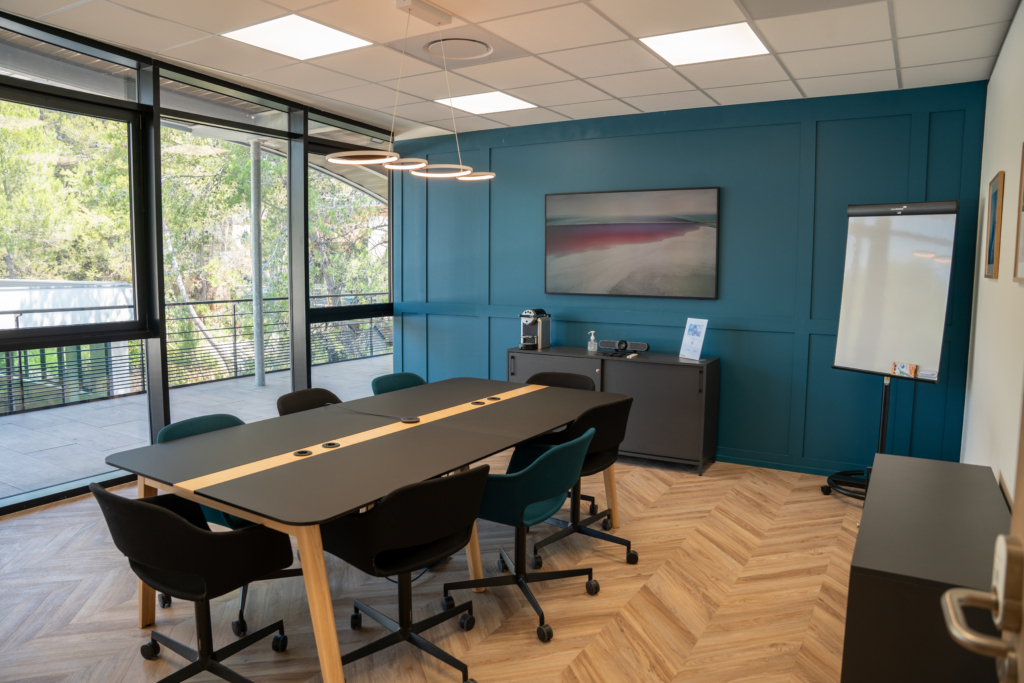
This proximity between businesses located on the same site fosters professional networking. As a result, several SMEs based at Flex-O form partnerships or establish business connections directly within the network, without any special effort on their part.
Flex-O also enriches the atmosphere at its centers with seasonal events throughout the year: Christmas parties, back-to-school get-togethers, and summer activities. These highlights strengthen the teams’ sense of belonging and create a friendly atmosphere at the centers.
Finally, each center features flexible spaces that can accommodate seminars, training sessions, or client events without the need to rent an external venue. This allows an SME to host its partners in a professional setting, on-site, and at a lower cost.
These spaces complement the shared services already offered: BREEAM-, HQE-, or WELL-certified buildings, a reception area, fully equipped meeting rooms, and an e-concierge service.
To find the location that best suits your business, view all available centers.
How to Choose Office Space as an SME: A Step-by-Step Guide
Once the criteria have been established, they still need to be applied in the right order. Here is a practical approach for turning these criteria into a decision.
To take a closer look at the comparison between the different plans available on the market
In conclusion: Choosing the Right Office for an SME
Choosing an office for an SME involves balancing three priorities: budget control, contractual flexibility, and the quality of the work environment provided to employees. A traditional commercial lease is suitable for stable, established organizations, while a private office in a flexible workspace is ideal for growing SMEs that want to preserve their cash flow.
With rates ranging from €350 to €900 per month depending on the city and level of service, private offices are now emerging as a credible middle ground between open-plan offices and traditional leases. Cities such as Bordeaux, Montpellier, and Nancy illustrate this rise in flexible office options in regional areas.
To get an accurate estimate based on the size of your team, you can request a free audit from Flex-O and compare the plans available at all of its locations in France.
To move on to the next step, explore all the Flex-O centers available throughout France.
Photo credits: qunica.com, AboutLife – stock.adobe.com