An office suited to a very small business combines three key qualities: controlled costs, a floor area tailored to the actual number of employees, and contractual flexibility. A very small business often grows rapidly, so it needs a space that keeps pace with its growth.
A very small business (TPE ) employs fewer than 10 employees and has annual revenue of less than 2 million euros ( Source: INSEE). This definition explains why the real estate needs of a very small business differ from those of a larger organization.
To learn more about the day-to-day benefits of coworking for a small business, our dedicated article details the tangible advantages beyond just the price.
Read the article: Coworking Spaces for Microbusinesses and Small and Medium-Sized Enterprises
What office solutions are available for a very small business?
Several office formats for very small businesses are available on the French market. Each one meets a different need depending on the size of the team and the available budget.
The Private Office in a Coworking Space
A private coworking office—also known as a managed office or flex office—is a closed-off space, sometimes an entire floor, that is rented fully equipped and with all services included (utilities, furniture, internet, reception), without a commercial lease. It offers the privacy of a traditional office, with a short-term commitment and a single monthly payment.
This option is particularly well-suited for very small businesses with 2 to 9 employees that are looking for a stable professional environment, with a short-term lease rather than a long-term lease.

To compare the key considerations for these different plans in more detail, a dedicated guide outlines the criteria you should review before signing.
Why should a very small business choose a flexible coworking space over a commercial lease?
Coworking addresses the specific challenges faced by very small businesses: the need to maintain cash flow, uncertainty about future headcount, and a desire to focus on their core business rather than on property management.
A commercial lease commits the company to a nine-year term, with a security deposit equivalent to several months' rent. This rigidity is ill-suited to a growing microbusiness, whose space requirements can double or decrease within a few months.
A national network of centers also provides access to multiple locations under a single contract—a solution that is particularly well-suited for distributed teams and executives who travel frequently.
To help you decide based on your stage of development, we've listed the two models side by side.
Read the comparison: 3/6/9-month lease vs. flexible office space
How much does an office cost for a very small business in France?
The cost of an office for a very small business ranges from €150 to €900 per month, depending on the city, the type of workspace, and the services included. A flexible workspace in an open-plan office costs between €150 and €400 per month, depending on the city, while a private office costs between €350 and €900 per month (Source: Ubiq).
In Paris, the average price of a coworking desk is €689 per month (Source: Ubiq), compared to €373 per month in Lyon (Source: Ubiq) and €329 per month in Nantes (Source: Ubiq). This difference reflects the tight real estate market and the density of local supply.
A private office in a major city like Lyon or Bordeaux generally falls within these price ranges, with most providers offering plans that do not require a large security deposit. Coworking offers savings of about 42% compared to renting an equivalent space in a traditional office, once rent, utilities, and setup costs are factored in (Source: BureauxLocaux).
For a detailed calculation that includes rent, utilities, and renovations, a comprehensive analysis breaks down each expense category.
Read the article: The True Cost of an Office for an Employee
What criteria should a very small business use to choose the right office?

Location and Accessibility
Proximity to public transportation and customers directly affects the company’s appeal to employees and partners. A location with good transportation access also makes it easier to welcome visitors.
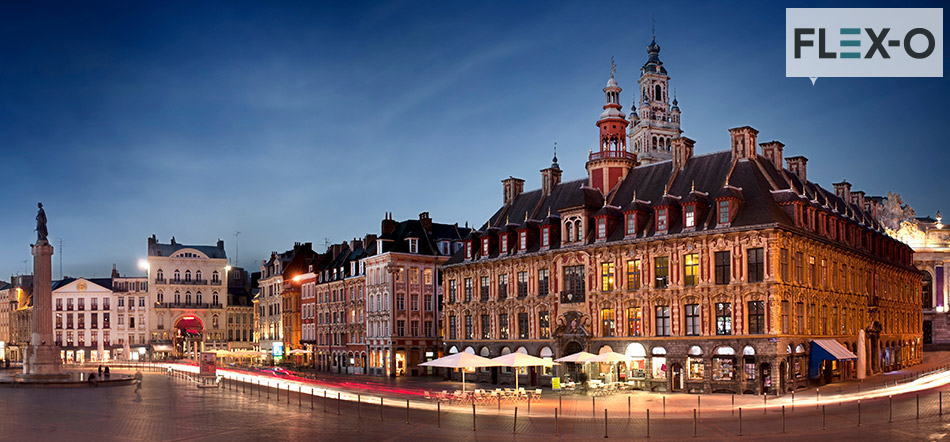
Cities such as Lille, Nice, and Sophia Antipolis exemplify this approach, with locations designed to ensure accessibility for both teams and clients.
For a detailed overview of the local market, check out our guides on office rentals in Lyon Part-Dieu and Paris highlight the unique characteristics of each business district.
Budget and Value for the Money
The budget allocated to office expenses should remain proportional to the microbusiness’s revenue, generally between 5 and 10 percent of fixed costs, depending on the size of the team. Comparing several service providers in the same area remains the most reliable way to assess value for money.

Flex-O, a flexible office solution for small businesses
Flex-O offers private offices and coworking spaces in about ten French cities, with locations in Lille, Nice Airport, Sophia Antipolis, Lyon, and Bordeaux, among others. Rates range from €350 to €900 per month depending on the city, with no large security deposit required.
The buildings are BREEAM- or HQE-certified, and Flex-O is recognized as a mission-driven company. This is a valuable consideration for very small businesses committed to CSR initiatives. In addition, the “Coworking Nomade” plan provides access to multiple centers under a single contract—a solution designed for distributed teams and executives on the go.
Each center also has an event space that can be reserved for private use and regularly hosts key events in the center’s calendar: Christmas, St. Patrick’s Day, Easter, and other occasions that mark the year. These shared moments bring the center to life and bring all the residents together, strengthening the sense of community on a daily basis.
To find the location that best suits your business, view all available centers.
In conclusion: Which office should a very small business choose in 2026?
When choosing an office for a very small business, the most important factors are the size of the team, the available budget, and the outlook for the business’s growth. For most small businesses, a private office in a coworking space offers the best balance between flexibility, cost control, and a professional image.
To move on to the next step, explore all the Flex-O centers available throughout France.
Photo credits: InfiniteFlow, Standret, Fahng – stock.adobe.com